
Some of my Oakland condo sellers are looking at a sale price close to what they paid ten years ago. We go through the numbers, and some decide to stay put.
That is a hard conversation. They have owned the home for years, made mortgage payments, taken care of the place, and expected more appreciation. Now selling may leave them with much less than they had pictured.
The first thing I want to know is what they plan to do next. A disappointing sale price matters. So does the price of the home they would buy afterward.
That is where the “Bay Area home values at decade lows” story becomes useful—and where the headline needs a little explaining.
What ten years of ownership actually bought you
Equity and appreciation get mixed together all the time.
Appreciation is an increase in the home's value. Equity is the value you own after subtracting the mortgage balance. Paying down principal can build equity even when the home's price barely moves. The interest portion of the payment goes to the lender.
So an owner can have money coming out of a sale even if the property sells around its original purchase price. Whether that owner made a profit is a different calculation, involving selling costs, improvements, financing, and other expenses.
For the sellers I work with, that distinction shows up on the net sheet. The loan balance may have come down enough to make a move possible. But the appreciation they expected to help fund the next purchase may be missing.
Some of the hardest conversations involve people who bought in 2021 or 2022. They competed, paid aggressively, and financed at a low rate. Now they want to recover that purchase price from buyers looking at a very different monthly payment.
The seller remembers what it took to win the house. The buyer is calculating what it takes to own it today.
The report is about purchasing power
The San Francisco Chronicle's November 16 report, using Zillow data through September 2026, found inflation-adjusted values in Richmond and Napa near their lowest levels in roughly a decade. Vallejo was at its lowest since 2017. Reported nominal typical values were approximately $601,000 in Richmond, $862,000 in Napa, and $517,000 in Vallejo. San Francisco's values rose over the latest year.
The important words are inflation-adjusted. The finding says those values have lost ground after accounting for what a dollar buys. It does not put every home's asking price back where it was ten years ago.
Here is a simple hypothetical. A home rises from $600,000 to $750,000, a 25% increase. If the general price level rises 30% during the same period, that $750,000 is worth about $577,000 in the earlier year's dollars. The dollar price went up while the purchasing-power value went down.

Zillow's Home Value Index measures typical values across a defined housing market. An Oakland condo owner's resale estimate is a separate, property-level question. Both can tell us something useful, as long as we keep their geography and measurement attached.
For a buyer in Berkeley or Alameda, I would start with comparable homes in that search. A Richmond finding is interesting context; the next offer still needs evidence from the properties competing for that buyer.
The payment can erase the price discount
This is why a seller can feel the home is cheaper while the buyer feels it is still expensive.
Consider these hypothetical purchases, each with 20% down and a 30-year fixed loan:
| Purchase price | Interest rate | Monthly principal and interest |
|---|---|---|
| $700,000 | 3% | About $2,361 |
| $700,000 | 7% | About $3,726 |
| $650,000 | 7% | About $3,460 |
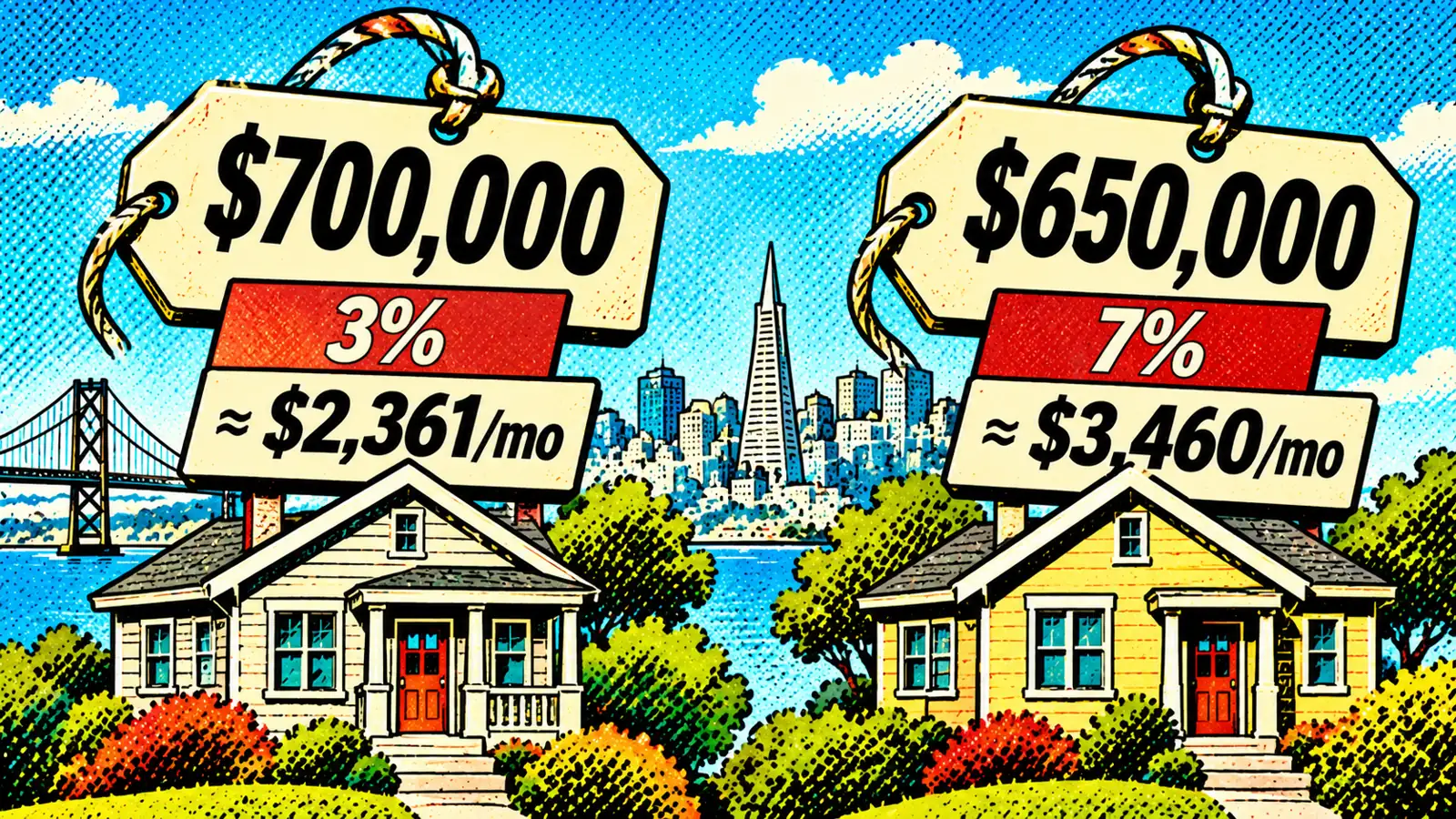
These are illustrations, excluding taxes, insurance, dues, and maintenance. Even after a $50,000 price reduction, the third buyer pays about $1,100 more each month than the first.
That is a lot of room in a household budget. It explains why comparing today's asking price with a pandemic-era sale can leave buyer and seller talking past each other.
For an actual purchase, have a lender work through the payment and cash to close. The CFPB's Loan Estimate guide explains where those figures appear. Then add the ownership costs for the specific address, including the association's finances if it is a condo.
Look at the move, not just the sale
If a seller wants to move up, we need both prices on the same page.
Say, hypothetically, the current home has dropped $100,000 from a previous reference point, while the replacement home has dropped $200,000. The difference between the two has narrowed by $100,000. That can create an opportunity even though the seller dislikes the first number.
The new financing still needs to work. A smaller price gap can come with a much larger mortgage payment, and selling expenses, taxes, and repairs belong in the comparison too.
For someone moving out of the Bay Area, the calculation changes again. Their proceeds may buy substantially more in the next market. The question becomes what their money does there, along with any change in work, income, and daily life.
And for an owner who has no urgent reason to move and nowhere they particularly want to go, waiting may make sense. Staying should fit the household's needs and budget, rather than depend on a prediction that a particular price will return.
Start with three numbers
Before deciding whether this is a good or bad time to sell, I want a realistic sale-price range, estimated net proceeds, and a complete budget for the next move.
That is more useful than debating the highest price the house might once have brought. A buyer will compare your home with what is available now: similar condition, layout, location, and monthly cost. Your plans deserve the same current information.
Sometimes the numbers say wait. Sometimes they say a move is more achievable than the headline suggests. And sometimes life has already made the timing decision.
If you have to sell, you have to sell. The job then is to make the move work with the market you have.
Explore Oakland neighborhoods and city guide ↗
Read more: America Has More Homes for Sale. The Oakland Housing Market Has Other Plans. ↗